
The Ivory Coast is a country in West Africa. It has a complex territorial organization, but well-defined. From 2011 to 2014, it was restructured into two autonomous districts and twelve regional districts.
Each region is then divided into departments. In total, the country has 509 sub-prefectures. This is the smallest administrative unit in the Ivory Coast.
This division allows for fine management of the territory. Thus, it is possible to better take care of more than 8,000 villages and 201 municipalities.
Main key ideas:
- The Ivory Coast has 509 sub-prefectures spread across its national territory.
- These sub-prefectures constitute the smallest administrative unit of the country.
- They are distributed across 31 administrative regions and 108 departments.
- The Ivorian territorial division was thoroughly reorganized between 2011 and 2014.
- The sub-prefectures play an essential role in local governance and economic development.
The territorial organization of the Ivory Coast
The Ivory Coast is divided into several zones. These zones are called administrative regions and territorial constituencies. Each zone has its own level of local governance. There are autonomous districts like Abidjan. And there are also sub-prefectures and departments.
Autonomous districts and regional districts
There are two autonomous districts in the Ivory Coast: Abidjan and Yamoussoukro. Each of these districts has regional districts. In total, there are twelve regional districts that cover the areas of the country.
Regions and departments
The districts are divided into 31 administrative regions. Then, these regions are further divided into 108 departments.
Sub-prefectures and villages
The departments house 509 sub-prefectures. Each sub-prefecture contains more than 8,000 villages. It is the smallest level of administrative division.
This territorial division helps the country manage its development. It allows for the implementation of decentralization policies and local development actions, while also considering the response delays that may occur in the process.
Evolution of the Ivorian administrative division
Reforms of 2011-2014
Between 2011 and 2014, the Ivory Coast modified its administrative division. This saw the creation of the autonomous districts of Abidjan and Yamoussoukro. Additionally, the country revisited its regions, departments, and sub-prefectures.
Former regions merged to form new districts, such as the creation of the Woroba district. This was done by combining the former regions of Bafing and Worodougou.
Other changes led to the birth of districts like Sassandra-Marahoué and Gôh-Djiboua. Some areas, like the Bandama Valley, are now designated as districts, although their territory remains the same. In total, 14 districts were created, including 12 regular and 2 autonomous, during this phase of reforms.
These adjustments reshaped the organization of the Ivory Coast. They reorganized the regions, departments, and sub-prefectures of the country. Today, the Ivory Coast has 509 sub-prefectures distributed across its administrative division.
How many sub-prefectures are there in the Ivory Coast?
The Ivory Coast currently has 509 sub-prefectures. They are spread throughout the territory. Each sub-prefecture is the smallest administrative unit of the country.
The sub-prefectures help with better local management. They bring the administration closer to the citizens. Each sub-prefecture contributes to the administration and development of its area.
The 509 sub-prefectures are not evenly distributed. Some areas have more than others. This distribution adapts to the needs of each region.
Thanks to this precise division, the Ivory Coast benefits from more effective management. It also helps to coordinate policies. And it reduces the development gaps between regions.
This sub-prefecture system is very important for decentralization and governance in the country, especially regarding the preparation of prefectural documents.
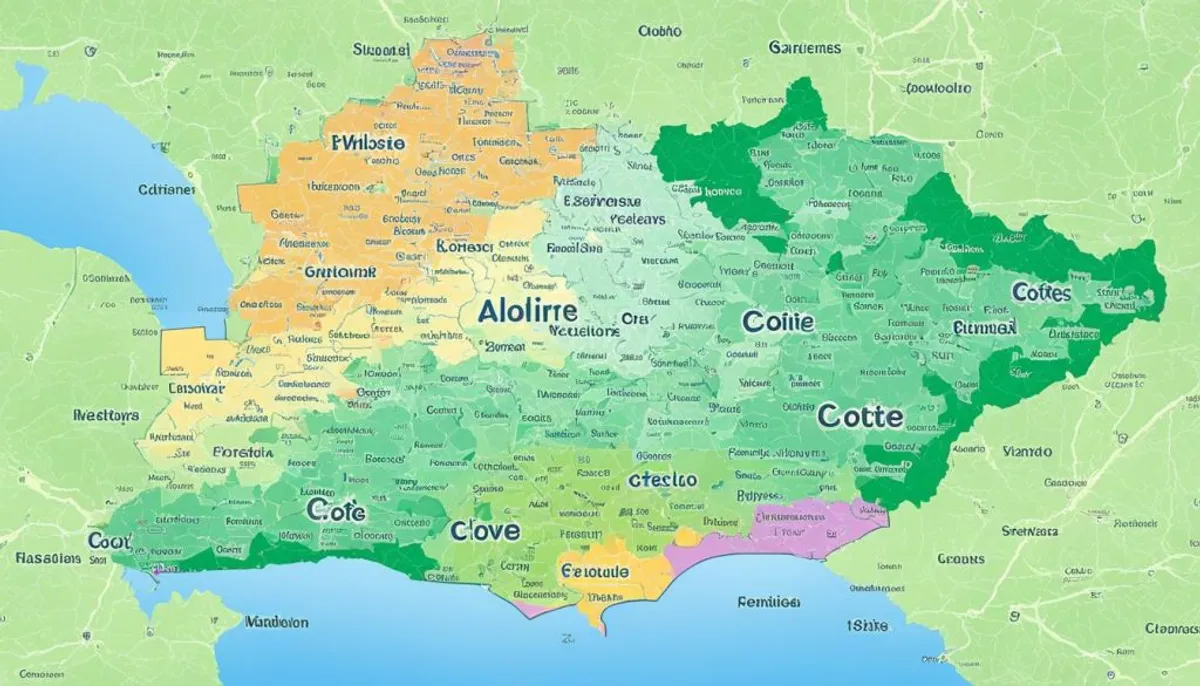
Geographical distribution of sub-prefectures
The Ivory Coast has 509 sub-prefectures. They are distributed throughout the territory. These sub-prefectures are the smallest administrative unit of the country. Each part of the country has a certain number of sub-prefectures. They also vary in population.
Autonomous district of Abidjan
Abidjan is the economic capital of the Ivory Coast. It has 27 sub-prefectures. Some are part of Urban Abidjan, while others are part of Rural Abidjan. Together, these areas have a population of 4,707,404. Abidjan is thus the largest demographic hub in the country.
Autonomous district of Yamoussoukro
Yamoussoukro is the political capital. It has only 2 sub-prefectures. Its population is 355,573. Even though it is small, this district is important for the administration of the country.
District of Bas-Sassandra
Bas-Sassandra is located in the southwest. It has 44 sub-prefectures. These sub-prefectures are in the regions of Gbôkle, Nawa, and San-Pédro. With 2,280,548 inhabitants, it is one of the main regional hubs.
District of Comoé
Located in the southeast, Comoé has 30 sub-prefectures. They are in the regions of Indénié-Djuablin and South Comoé. Its population is 1,203,052.
Role of sub-prefectures
In the Ivory Coast, sub-prefectures play an important role in local administration. They are the smallest administrative unit of the country. They represent the state at a very local level.
Their main mission is to operate local public services. They also ensure that national political decisions are implemented in their administrative constituencies.
Local administration
In the Ivorian administrative regions and departments, sub-prefectures are important. They coordinate the actions of local communities and the decentralized services of the state.
They serve as a link between the central government and local authorities. This allows for close management, which directly benefits the residents, especially concerning administrative procedures at the prefecture.
Economic development
Another key role of sub-prefectures is to stimulate the local economy. They lead projects to boost development. They also encourage local initiatives from businesses and associations.
Governance and decentralization
In the Ivory Coast, the policy of decentralization aims to be effective. Its goal is to bring the administration closer to the citizens. Thus, it strengthens local management. This is done through an administrative division into sub-prefectures.
This division aims at several objectives. It ensures a better representation of the state at the local level. It also allows for a more efficient management of resources and development projects.
With the establishment of 509 sub-prefectures, powers are decentralized. Responsibilities shift to local authorities. Municipalities become more involved in public management. They also fund development projects.
Even though progress has been made, challenges persist. It is necessary to strengthen the capacities of elected officials and civil servants. Coordination between levels of government is essential. Moreover, it is necessary to reduce regional disparities in access to public services.
The division into sub-prefectures is vital for decentralization in the Ivory Coast. It improves the relationship between the administration and the citizens. By promoting better governance, it makes local decisions more accountable.
Issues and challenges of territorial subdivisions
The division of the Ivory Coast into sub-prefectures is crucial. It helps to better organize the country and develop it. However, this division poses significant challenges to overcome.
One difficulty is the fair management of resources in these areas. It is hard to allocate money, buildings, and public services equitably. This can worsen inequalities between regions.
Coordinating government actions at this level is also complex. It requires real collaboration between local elected officials and the central administration. Ensuring that all sub-prefectures pursue the same goals is not easy. This diminishes the effectiveness of the projects implemented.
Even with this division, less developed areas are sometimes left behind. They do not benefit as much from services and buildings as those that are better off. This creates disparities that pose problems. To remedy this, it is essential to fill out the prefectural form to access specific resources and assistance.
Overcoming these obstacles requires better territorial management. The country should move towards strong local governance. Resources should be better utilized, and a balanced development approach adopted. With real efforts at all levels, it is possible to optimize these sub-prefectures for the benefit of all.
Importance of geographical data
Understanding where the sub-prefectures in the Ivory Coast are located is crucial. This is important for digital mapping and the management of territories. With this data, accurate demographic statistics can be obtained. This helps to plan and implement effective public policies.
Digital mapping
Digital mapping uses geographical data to show the Ivorian administrative subdivisions. This is very important for understanding where the sub-prefectures are located. It also allows us to see the disparities between areas of the country.
Demographic statistics
Knowing the demographic situation in each sub-prefecture is essential. This information aids in planning public policies by providing facts about the population. We can make better decisions and share resources equitably across the national territory. Moreover, this aspect aligns with the principles outlined in Article 72 of the Constitution.
List of sub-prefectures by region
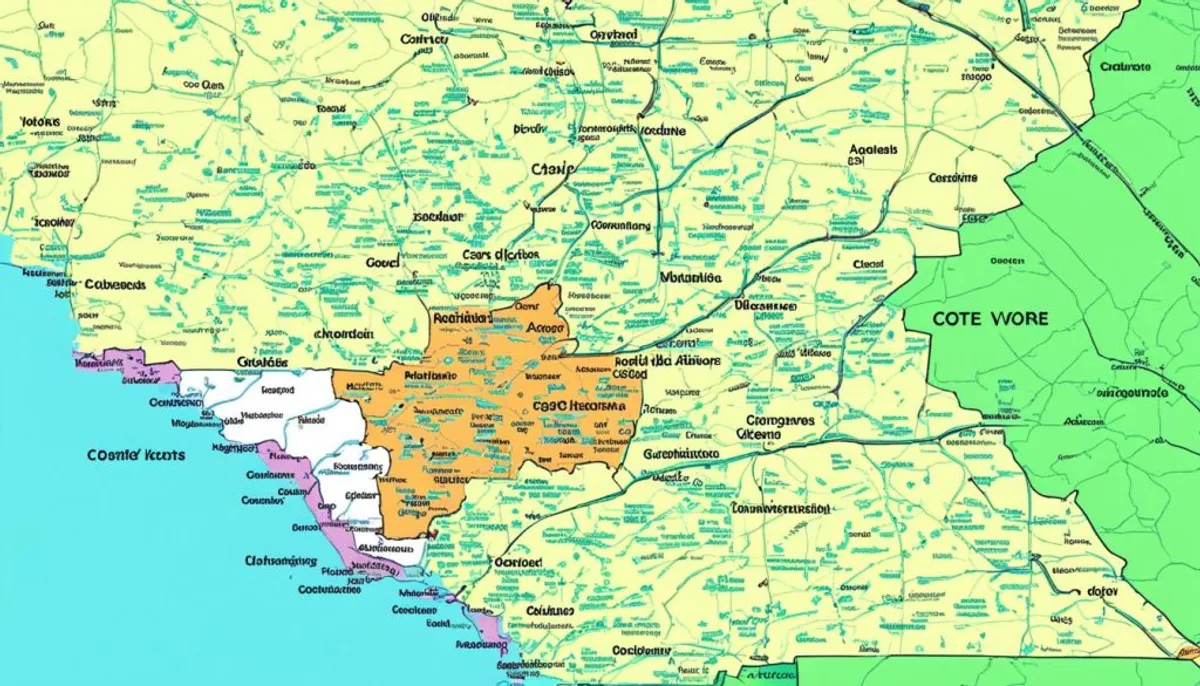
The Ivory Coast has a total of 509 sub-prefectures. They are distributed across its various regions and districts. Here is how they are divided:
| Region/District | Number of sub-prefectures | Main cities/regions |
|---|---|---|
| Autonomous district of Abidjan | 27 | Urban Abidjan (13), North Abidjan (3, 190,633 inhabitants) |
| Autonomous district of Yamoussoukro | 2 | Yamoussoukro (310,056 inhabitants) |
| District of Bas-Sassandra | 44 | Gbôkle (400,798 inhabitants), Nawa (1,053,084 inhabitants) |
| District of Comoé | 30 | Indénié-Djuablin (560,432 inhabitants), South Comoé (642,620 inhabitants) |
| District of Denguélé | 20 | Folon (96,415 inhabitants), Kabadougou (193,364 inhabitants) |
| District of Gôh-Djiboua | 37 | Gôh (876,117 inhabitants), Lôh-Djiboua (729,169 inhabitants) |
| District of Lakes | 34 | Bélier (346,768 inhabitants), Iffou (311,642 inhabitants) |
| District of Lagunes | 36 | Agnéby-Tiassa (606,852 inhabitants), Grands-Ponts (356,495 inhabitants) |
| District of Mountains | 79 | Cavally (459,964 inhabitants), Guémon (919,392 inhabitants), Tonkpi (992,564 inhabitants) |
The 509 sub-prefectures are located throughout the Ivory Coast. This distribution shows how the country is organized administratively. Each area has its own local government.
Management of borders and security
The division into sub-prefectures helps to better monitor the borders. This enhances security throughout the country. Thanks to this division, each part of the country is better controlled.
The “COCOTIP” program from Germany has helped to open two new police stations. One in Ohidougou in Ouaninou and the other in N’gadana. Ohidougou is in the Bafing region, while N’gadana is in Poro.
These stations add to 12 others already opened since 2018. For example, Soko in the Bondoukou department is part of these new stations.
| Police stations inaugurated in 2022 | Modern border posts acquired since 2018 |
|---|---|
| 2 | 12 |
This division helps to better combat certain illegal activities. More numerous and modern police stations strengthen surveillance.
Prospects for the evolution of territorial division
Discussions are taking place about the division of the Ivory Coast. The goal is to improve our efforts to manage our territory. This includes better organization between levels of government, more decentralization, and the reduction of regional inequalities.
To achieve this, revisiting the organization of our regions, departments, and sub-prefectures is an option. This would allow for better responses to the needs of the inhabitants. In-depth studies on demographic, economic, and social aspects help to make good decisions.
It is crucial to improve how we collect and manage data about our space and our figures. A significant effort is underway to gather this information. The goal is to use it to plan and implement upcoming changes.
These reflections show that the Ivorian government is ready for major changes. These efforts aim to better develop the country and make our local government more effective. Communication with administrations is essential to ensure that the upcoming transformations are well understood and implemented. The coming years are likely to see significant transformations in our administrations.
Conclusion
The Ivory Coast has 509 sub-prefectures in total. They are the smallest administrative area of the country. This division greatly aids in local management and economic development. But it also creates challenges to face.
Sub-prefectures are very important for organizing the Ivorian territory. They allow people to have easier access to administrative services. This makes governance closer to the needs of the population.
For the future, improving decentralization is crucial. This involves giving more power to local actors. Thus, we will be able to better utilize the current territorial division and serve citizens as they deserve.
It is also vital to modernize management and enhance geographical data. These changes will be key to overcoming upcoming challenges. Together, they will help improve the lives of people living in these areas.
FAQ
How many sub-prefectures does the Ivory Coast have?
The Ivory Coast currently has 509 sub-prefectures. These are the smallest administrative areas of the country.
How is the Ivory Coast organized at the territorial level?
The Ivory Coast has two autonomous districts and twelve other districts, forming 31 administrative regions. Each region is then divided into departments and sub-prefectures.
The departments are subdivided into 108 departments. These, in turn, become 509 sub-prefectures.
What are the main reforms of the Ivorian administrative division?
Between 2011 and 2014, several reforms took place. This includes the creation of autonomous districts and adjustments in the division of territories.
What is the geographical distribution of sub-prefectures?
Abidjan has 27 sub-prefectures and Yamoussoukro has 2. In Bas-Sassandra, there are 44 sub-prefectures, while Comoé has 30.
What is the role of sub-prefectures in the Ivory Coast?
Sub-prefectures are very important for local administration. They help with economic development by supporting local projects.
How does the division into sub-prefectures fit into local governance?
This division is part of a decentralization plan. It aims to improve local governance in the Ivory Coast.
What are the issues and challenges related to the current territorial organization?
The division poses challenges such as resource management and the coherence of public policies. It must also reduce differences between regions.
What is the importance of geographical data on sub-prefectures?
This data is crucial. It is used to map and manage territories. Additionally, it helps to plan policies based on accurate statistics, particularly by identifying a available prefecture slot for targeted interventions.
Where can we find the list of sub-prefectures in the Ivory Coast?
A complete inventory of the 509 sub-prefectures exists. It shows their distribution across the country.
What role do sub-prefectures play in border management and security?
They play an important role, particularly in border control and protection throughout the Ivorian territory.
What are the prospects for the evolution of territorial division in the Ivory Coast?
Due to current challenges, restructuring is under discussion. New ways of dividing the country are being considered.