
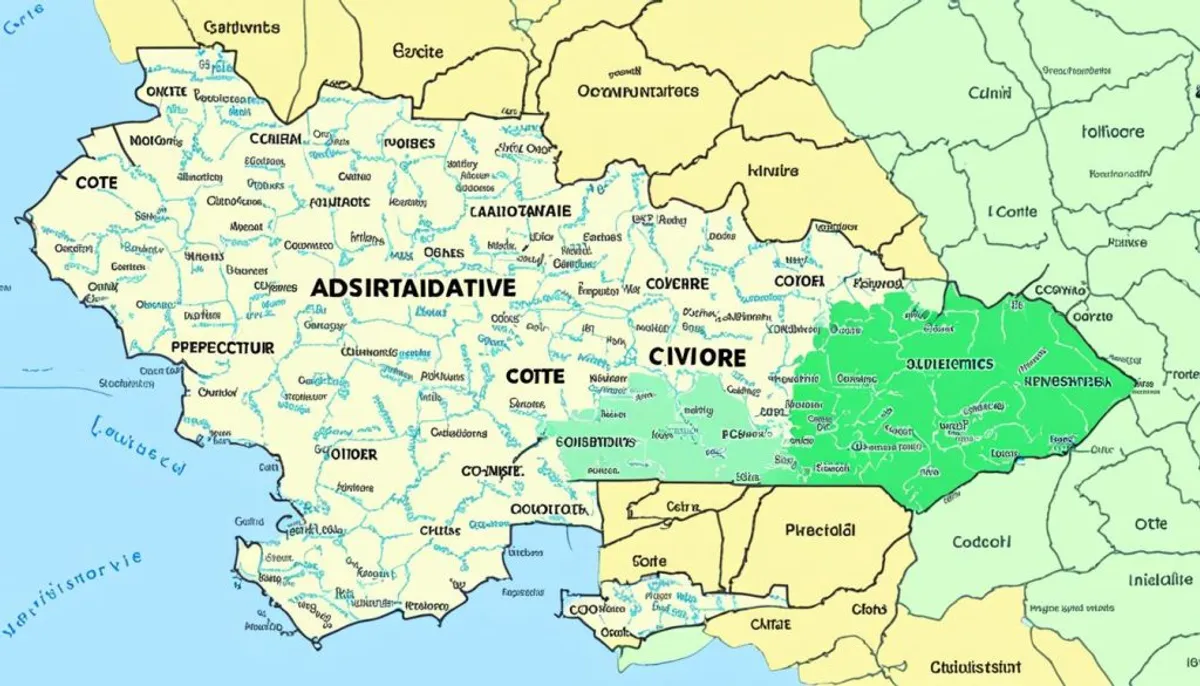
The Ivory Coast is a country in West Africa. It is organized into 12 administrative districts. However, only 2 of these districts really function. These are the autonomous district of Abidjan and the autonomous district of Yamoussoukro, the political capital.
The other districts are not active at the moment. This way of organizing the country allows residents to be closer to the government. This is called the decentralization of power. It is important to understand how the administration in the Ivory Coast works.
- The Ivory Coast has 12 administrative districts, of which only 2 are functional (Abidjan and Yamoussoukro).
- The Ivorian administrative organization is structured around the principles of deconcentration and decentralization.
- The territorial subdivisions include regions, departments, sub-prefectures, and villages.
- Abidjan is the economic capital of the country and the most populated autonomous district.
- Understanding the administrative division of the Ivory Coast is essential to grasp its institutional functioning.
Introduction to the Administrative Organization of the Ivory Coast
The administrative organization of the Ivory Coast follows the French colonial model. It is based on deconcentration and decentralization. This allows for better management of the territory and brings the administration closer to citizens throughout the country.
Currently, there are 12 administrative districts in the Ivory Coast. Among them, only 2 autonomous districts are fully operational. These are Abidjan and Yamoussoukro. The country is divided into 31 regions, 108 departments, and 509 sub-prefectures. This forms a complex administrative network.
Locally, there are more than 8,000 villages across the Ivory Coast. The decentralization has also created 204 municipalities. Each municipality has its own decision-making authorities.
This organization is inspired by the French system. However, it also reflects the will of the Ivorian authorities. They aim to structure their state effectively. And they seek to improve the work of the administration throughout the country.
The Objectives of Administrative Deconcentration
The Ivory Coast aims for several administrative deconcentration objectives. It wants to improve the goals of Ivorian administrative deconcentration and the purposes of administrative deconcentration. These goals include:
Bringing Administration Closer to the Population
An important goal is to bring the administration closer to the people. This improves local public service. Local needs are better understood and addressed.
Relieving the Burden on Central Power
Administrative deconcentration helps reduce the burden on central power. It shares responsibilities across the territory. Thus, management adjusts better to local conditions.
Disseminating and Implementing Central Decisions
The ultimate goal is to better disseminate and implement central decisions. Therefore, local actions are more coherent. Coordination between policies improves.
Thus, all the administrative deconcentration objectives of the Ivory Coast, the goals of Ivorian administrative deconcentration, and the purposes of administrative deconcentration serve to make public action closer, more responsive, and effective throughout the Ivory Coast.
The Levels of Administrative Deconcentration
In the Ivory Coast, the administration is organized into several levels of deconcentration. Each of these levels is important for managing the territory and being close to the people. These include:
The Districts
There are 12 administrative districts in the Ivory Coast. However, only those of Abidjan and Yamoussoukro are truly active. These districts encompass several regions. They are situated between the national level and the regions.
The Regions
There are 31 Ivorian regions. They play a key role in economic, social, and cultural development at the local level. The regions are of great importance in the administrative decentralization of the country.
The Departments
The Ivory Coast has 108 departments. They lie between the region and the sub-prefecture. These departments are crucial for the relationship between the different levels of local administration.
The Sub-Prefectures
There are a total of 509 sub-prefectures. They supervise the work of village chiefs in their territory. This helps implement the decisions of the central government at the local level.
The Villages
Villages are the foundation of the administrative division in the Ivory Coast. They form the most detailed territorial network in the country.
Administrative Decentralization in the Ivory Coast
Administrative decentralization in the Ivory Coast transfers powers from the state to local authorities. These authorities become autonomous with their own decision-making bodies. The goal is to bring the administration closer to citizens. It also aims to empower local authorities to manage their own affairs.
Definition of Decentralization
In the Ivory Coast, administrative decentralization means that the state shares its power. It shares it with places like regions and municipalities. These places obtain a legal personality and can make decisions independently.
Objectives of Decentralization
Decentralization has several goals in the Ivory Coast. It aims to:
- Give more power to local authorities to manage their affairs
- Better listen to and respond to local needs through a better understanding of the populations
- Involve citizens more in public decisions through enhanced participation
- Make public action more effective and swift throughout the territory.
The Decentralized Local Authorities
In the Ivory Coast, there are 204 municipalities and 31 regions. These local authorities are very important. They manage many affairs close to the residents.
The Municipalities
The municipalities are the first level of decentralization here. Each has its own administrative and financial life. Local elected officials lead actions to meet local needs, particularly regarding the increase in vehicle registration fees.
The Regions
The regions form the second level of decentralization. There are 31 of them, not counting the autonomous districts. They focus on local economic and social development, and the territorial division plays an essential role in this organization.
Even though they do not have the power to make laws, the regions are key. They help organize public life in their territory.
In 2014, a law changed the number of districts in the Ivory Coast. Now, only Abidjan and Yamoussoukro have a special status. They are the only active districts in the country.
The autonomous districts encompass several administrative levels. This clearly shows how the administration functions locally in the Ivory Coast.
Abidjan, Economic Capital and Former Capital
Abidjan is the economic capital of the Ivory Coast. It is located in the south, on the Gulf of Guinea. The city is traversed by the Ébrié lagoon and extends about twelve kilometers from north to south, and ten from east to west.
Geographical Location of Abidjan
In 2021, Abidjan had 6,321,017 inhabitants. With a density of 2,983 inhabitants per km2, it represents 21.5% of the country's population. The city also generates about 60% of the Ivory Coast's gross domestic product.
Climate of Abidjan
Abidjan has a hot and humid equatorial climate, typical of the coastal region. Temperatures range from 24°C to 32°C throughout the year.
Territorial Division of Abidjan
Abidjan is divided into municipalities. Among them, the most populated are Abobo and Yopougon, as well as the districts of Yopougon. It also includes Plateau, the business center, Cocody, home to many residential neighborhoods, and Marcory, a commercial residential area. Port-Bouët, a popular neighborhood, is located by the sea.
How Many Prefectures are in the Ivory Coast
The Ivory Coast has 12 administrative districts according to decree n° 2011-263. However, only 2 are truly operational today. These are the autonomous district of Abidjan and the autonomous district of Yamoussoukro, the political capital of the country. The other 10 districts have not started their work.
The country is divided into 31 regions, which are divided into 108 departments. These contain 509 sub-prefectures and various types of prefectures.
There are also 8,000 villages and 201 municipalities across the country, which requires effective management of sub-prefectures.
| Administrative Level | Number |
|---|---|
| Districts | 12 (of which 2 are functional) |
| Regions | 31 |
| Departments | 108 |
| Sub-Prefectures | 509 |
| Villages | 8,000 |
| Municipalities | 201 |
Since 2011, the Ivory Coast has changed its way of organizing its territory. This reform created 2 autonomous districts and 12 districts. It has allowed for better management of space and territories.
General Recommendations for a Stay in the Ivory Coast
The terrorist threat is low in the Ivory Coast, but it is important to remain vigilant. Avoid high-risk areas such as border regions with Mali and Burkina Faso. The same applies to the north of the Zanzan district and the east of the Savanes district. These places are dangerous due to the risks of attacks and kidnappings.
Terrorist Risks and Advised Areas to Avoid
The majority of the country is safe. However, it is advisable not to visit border areas with Mali and Burkina Faso. This also includes the north of the Zanzan district and the east of the Savanes. These places are high-risk in terms of security.
Road Risks
Road accidents are common in the Ivory Coast. Being very careful on the roads is essential. It is necessary to respect traffic laws and avoid driving at night.
Cybercrime and Scams
Cybercrime is a problem in the Ivory Coast. Protect your personal and banking information. Do not respond to suspicious messages, especially on social media.
Entry and Stay Formalities in the Ivory Coast
French citizens wishing to go to Ivory Coast must have a biometric visa. They can obtain it at the Consulate General of Ivory Coast in Paris or at www.snedai.com. They must also be vaccinated against yellow fever.
If you have pets, ensure they have a health record. An identification is also necessary. For a tourist vehicle, there are specific rules to follow for temporary importation.
Malaria is a risk in the Ivory Coast, transmitted by mosquitoes. It is essential to take preventive measures against this disease.
| Type of Visa | Validity Duration |
|---|---|
| Long-stay visa equivalent to residence permit (VLS-TS) | From 4 to 12 months |
| Visa mentioning "residence permit to be requested within 2 months of arrival" | Variable duration |
| "Holiday-work" visa | Maximum 1 year |
| Minor studying in France visa | Up to 11 months |
| Temporary long-stay visa | From 4 to 6 months |
Before visiting the Ivory Coast, be well informed about the entry formalities and the conditions of stay. Note the customs rules to be followed when entering the country.
Health Precautions for a Trip to the Ivory Coast
Before leaving for Ivory Coast, take care of your health. Ensure you have the vaccine against yellow fever. This vaccine is essential. Your vaccination record will be checked upon arrival. Updating your DTP vaccines and the vaccine against meningitis is also recommended.
Mandatory and Recommended Vaccinations
In addition to yellow fever, other vaccines may be important depending on your stay in Ivory Coast. Consult your doctor or a vaccination center to find out which vaccines you may need. Vaccines against Japanese encephalitis, tick-borne encephalitis, typhoid fever, hepatitis A and B, or rabies, for example, may be necessary.
Health Risks
Even if vaccinated, it is important to protect yourself from mosquito-borne diseases such as malaria. Use repellents and mosquito nets. Follow prevention advice. Adequate health insurance is also crucial. It covers any medical expenses that could be costly in the Ivory Coast.
| Vaccination | Recommendation |
|---|---|
| Yellow fever | Mandatory |
| DTP (Diphtheria, Tetanus, Polio) | Recommended |
| Meningitis | Recommended |
| Japanese encephalitis | Recommended for certain stays |
| Tick-borne encephalitis | Recommended for certain regions |
| Typhoid fever | Recommended for certain stays |
| Hepatitis A | Recommended |
| Hepatitis B | Recommended for certain stays |
| Rabies | Recommended for certain areas |
| Seasonal flu | Strongly recommended for certain groups |
Conclusion
The Ivory Coast offers a world of discoveries. It is a country rich in diverse cultures. Despite a complex administrative organization, your stay will leave beautiful memories.
It is important to follow safety and health advice. This will help you fully enjoy this adventure. Whether you go to Abidjan or explore other regions, the Ivory Coast will charm you.
Its dynamism and beautiful landscapes will amaze you. Before leaving, inform yourself about the entry formalities. The Ivory Coast truly deserves to be visited to discover new experiences.
FAQ
How many prefectures are there in the Ivory Coast?
According to decree n° 2011-263 of September 28, 2011, the Ivory Coast has 12 administrative districts. Among them, only Abidjan and Yamoussoukro are active.
What is the administrative organization of the Ivory Coast?
The organization follows the French colonial model. It is based on deconcentration and decentralization.
What are the objectives of administrative deconcentration in the Ivory Coast?
Deconcentration helps bring the administration closer to citizens. It also facilitates the actions of the state and strengthens its local impact.
What are the levels of administrative deconcentration in the Ivory Coast?
In the Ivory Coast, deconcentration operates through districts, regions, departments, sub-prefectures, and villages.
What is administrative decentralization in the Ivory Coast?
This means that the state cedes powers to autonomous local authorities. Each has its own competencies and decision-making bodies.
What are the main decentralized local authorities in the Ivory Coast?
The Ivory Coast has 204 municipalities and 31 regions that benefit from decentralization.
Where is the economic capital of the Ivory Coast located?
The economic capital is Abidjan, located in the southern part of the country, particularly in the southern Abidjan region. It is on the Gulf of Guinea, near the Ébrié lagoon.
What are the high-risk areas in the Ivory Coast?
The border regions with Mali and Burkina Faso pose risks. The north of Zanzan and the east of Savanes are also risky for attacks and kidnappings.
What are the entry and stay formalities in the Ivory Coast?
A biometric visa is required for French visitors. The yellow fever vaccine is also mandatory.
What health precautions should be taken for a trip to the Ivory Coast?
In addition to the yellow fever vaccine, update your DTP vaccines and get vaccinated against meningitis before leaving.