
Between 2011 and 2014, Côte d’Ivoire restructured its territorial division. Now, the country is organized into several levels: 2 autonomous districts, 12 districts, 31 regions, 108 departments, and 509 sub-prefectures. This means that, in 2024, there is a total of 509 sub-prefectures in Côte d’Ivoire.
Main ideas to remember
- Côte d’Ivoire has 509 sub-prefectures in 2024
- The country is divided into 2 autonomous districts, 12 districts, 31 regions, and 108 departments
- The Ivorian territorial division was reformed between 2011 and 2014
- Sub-prefectures play an essential role in local administration
- Detailed maps represent the geographical distribution of sub-prefectures
Introduction
Côte d’Ivoire is a country in West Africa. It has an area of 322,462 km². This country is divided into several administrative levels.
It has 2 autonomous districts, 12 districts, 31 regions, 108 departments, and 509 sub-prefectures. This structure helps manage the territory and promote development.
Overview of Côte d’Ivoire
In Côte d’Ivoire, sub-prefectures ensure good organization. They distribute tasks and resources locally. This helps bring public services closer to the residents.
This is what is called decentralization. It positively influences development and strengthens what is called Ivoirité.
Importance of administrative subdivisions
Sub-prefectures are part of a decentralization plan. This scheme aims to improve development throughout the country. It brings government decisions and actions closer to the people.
Territorial organization of Côte d’Ivoire
Côte d’Ivoire has a complex system of administrative organization. It consists of several territorial levels. This helps to better manage and develop the country locally.
Autonomous districts
There are 2 autonomous districts in Côte d’Ivoire. Each has its own rules and manages its affairs independently. These are the autonomous district of Abidjan and Yamoussoukro.
Regions
The territory is divided into 31 administrative regions. These are the next step after the autonomous districts. Each region includes several departments.
Departments
Each region is in turn divided into 108 departments. Each of these departments covers a specific area. And then there are sub-prefectures in each department.
Historical evolution of administrative division
From 2011 to 2014, Côte d’Ivoire revised its administrative division. This resulted in the creation of 2 autonomous districts, 12 districts, and 31 regions. These divisions were further subdivided into 108 departments and 509 sub-prefectures.
Reforms from 2011 to 2014
Before 2011, there were 510 sub-prefectures in Côte d’Ivoire. After the reform, the country was divided into 14 districts. The new organization helped better manage local competencies and resources. This encouraged regional development and strengthened national unity.
How many sub-prefectures does Côte d’Ivoire have in 2024?
In 2024, Côte d’Ivoire has 509 sub-prefectures, according to recent data. This figure is the result of the administrative changes from 2011 to 2014. It joins other divisions such as 2 autonomous districts, 12 districts, 31 regions, and 108 departments.
This territorial division is crucial for local life and the progress of Ivorian regions. Sub-prefectures are the smallest unit of this organization. They serve to bring public services closer to the residents.
Despite the importance of sub-prefectures, the situation is not without difficulties. There are issues with funding, buildings, and personnel. Ivorian leaders want to improve the situation. They plan to redefine territorial boundaries. This will help local development.
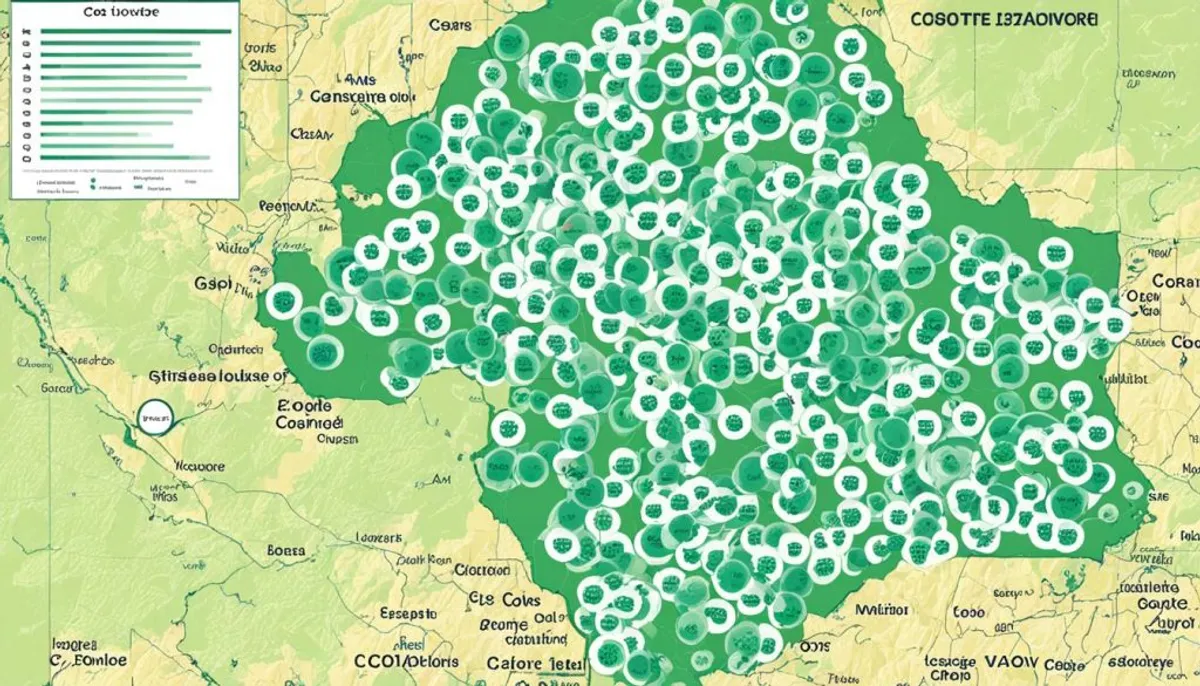
Distribution of sub-prefectures by region
Côte d’Ivoire has several districts. Each has a different number of sub-prefectures. Let’s see where these sub-prefectures are located in the major districts.
Autonomous district of Abidjan
Abidjan, the economic capital, has 27 sub-prefectures. They are in two areas: Urban Abidjan (16) and Rural Abidjan (11).
Autonomous district of Yamoussoukro
Yamoussoukro, the political capital, has only 2 sub-prefectures. They are Attiégouakro and Yamoussoukro.
District of Bas-Sassandra
Bas-Sassandra has 34 sub-prefectures in 3 regions. These regions are Gbôkle (12), Nawa (12), and San-Pédro (10).
District of Comoé
Comoé has 26 sub-prefectures in 2 regions. They are Indénié-Djuablin (15) and Sud-Comoé (11).
Role of sub-prefectures
Sub-prefectures are key in the local administration of Côte d’Ivoire. They connect the central state and local citizens. Their work involves managing policies, collecting funds, and more.
Sub-prefectures are essential in local administration. They make public services directly available to the people. This helps achieve more equitable development throughout Côte d’Ivoire.
On the ground, sub-prefectures greatly help strengthen Ivoirité and national identity. They serve as important links between the state and the residents. This fosters cohesion and harmonious progress of the country.
Challenges related to the management of sub-prefectures
The management of sub-prefectures in Côte d’Ivoire faces several significant challenges. These issues hinder the proper functioning of these local entities. They affect the management of financial resources, infrastructure, and qualified personnel.
Financial resources
A major challenge is the lack of budgetary means for sub-prefectures. They face a deficit of necessary resources to effectively handle local tasks. This includes managing public services and issuing documents.
Infrastructure
Another obstacle is related to insufficient infrastructure in the sub-prefectures. Many of them lack the necessary equipment and buildings. This makes it difficult to accommodate and assist citizens. Thus, the quality of local services is affected.
Qualified personnel
Recruiting and training competent administrative personnel is another challenge. Some areas struggle to attract and retain qualified employees. This decreases the efficiency of local administration.
| Challenges related to the management of sub-prefectures | Statistical data |
|---|---|
| Insufficient financial resources | Percentage of the budget allocated to sub-prefectures compared to other administrative units: [xx]% |
| Lack of suitable infrastructure | Infrastructure development rate in sub-prefectures: [xx]% |
| Difficulties in recruiting qualified personnel | Percentage of female administrative personnel in sub-prefectures: [xx]% |
The numerous challenges facing sub-prefectures in Côte d’Ivoire highlight the need for reinforcement. It is necessary to improve the means provided to them. Additionally, it is crucial to enhance the working conditions of personnel. This would allow for a quality public service for the local population.
Impact on local development
Sub-prefectures are crucial in Côte d’Ivoire. They provide essential proximity public services. This facilitates access to administrative tasks. Thus, they contribute to local development.
Their presence in the territory follows a logic of decentralization. This administrative choice brings local power closer to citizens and fits into a thoughtful territorial organization. It aims to balance the development of the country.
Maps of Ivorian sub-prefectures
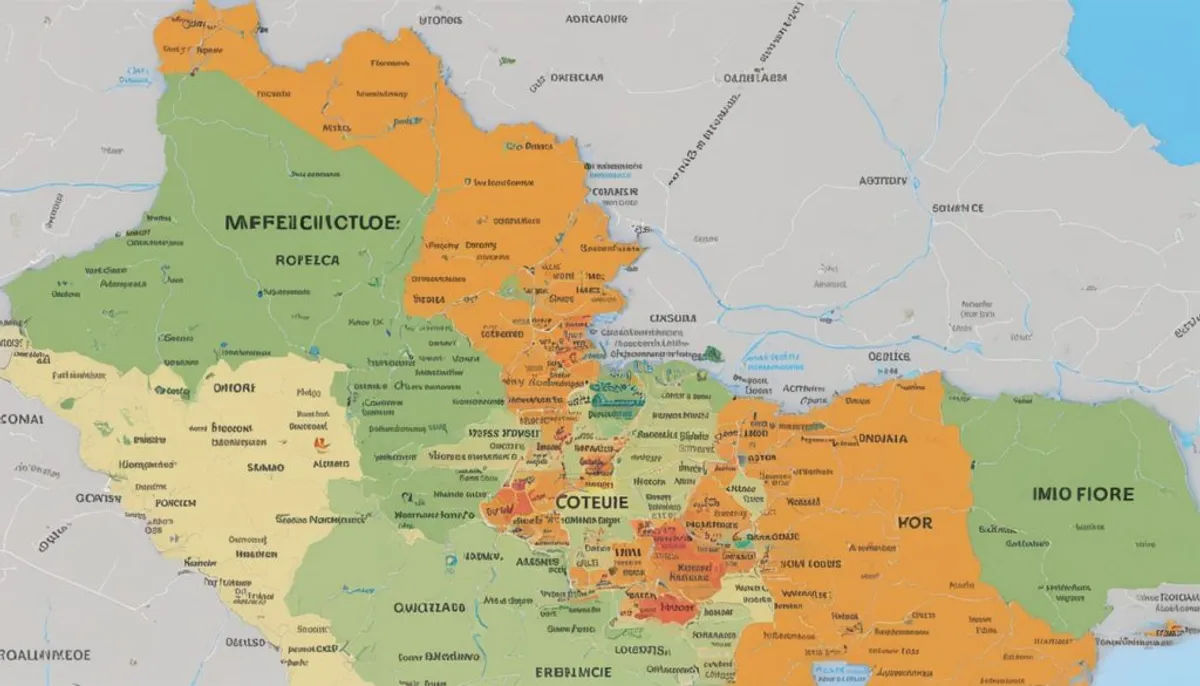
We have comprehensive maps of 509 sub-prefectures in Côte d’Ivoire. They show where these areas are located in each region and district of the country.
The maps of sub-prefectures in Côte d’Ivoire help understand the territory. They highlight the complexity of administrative divisions with its districts, regions, and sub-prefectures.
| Region | Number of sub-prefectures |
|---|---|
| Autonomous district of Abidjan | 27 |
| Autonomous district of Yamoussoukro | 2 |
| District of Bas-Sassandra | 34 |
| District of Denguélé | 25 |
| District of Gôh-Djiboua | 33 |
| District of Lakes | 24 |
| District of Lagunes | 27 |
| District of Mountains | 36 |
| District of Zanzan | 24 |
| District of Worodougou | 18 |
| District of Bafing | 16 |
| District of Tonkpi | 23 |
| District of Comoé | 26 |
| District of Poro | 24 |
These maps help to see how Côte d’Ivoire is organized. They provide an overview of the administrative infrastructure of the country.
Key statistical data
Côte d’Ivoire has 509 sub-prefectures, 108 departments, 31 regions, and 2 autonomous districts. In 2022, approximately 26 million people lived here.
Important statistics regarding the territorial division and sub-prefectures statistics in Côte d’Ivoire are available:
| Indicator | Value |
|---|---|
| Total area of Côte d’Ivoire | 322,463 km² |
| Total population in 2021 | 29,389,150 inhabitants |
| Nominal GDP in 2020 | 61.502 billion US dollars |
| GDP (PPP) in 2020 | 144.497 billion US dollars |
| Gross public debt in 2015 | 6,393.234 billion Franc CFA, representing 34.694% of GDP |
| Human Development Index (HDI) in 2021 | 0.550 (159th position) |
| Gini coefficient in 2018 | 37.2% |
| Gender inequality index in 2021 | 0.613 |
| Environmental performance index in 2022 | 32.8 |
The figures highlight the key role of administrative subdivisions in Côte d’Ivoire. The sub-prefectures assist in the country's economic and social development.
Prospects for the evolution of territorial division
The authorities in Côte d’Ivoire want to review how the country is organized. They are considering changing the number and size of administrative regions. This would be done according to local needs and for the progress of each region.
This change project aims to adapt administrative areas to real needs. The idea is to improve public services close to home. The authorities hope to better meet the expectations of the people living there.
Adjustments will be made in terms of administrative areas. They will take into account population figures, the economy, and social factors. This would mean an administration closer to needs, everywhere in Côte d’Ivoire.
This restructuring of administrative areas marks a step towards greater autonomy. It seeks to modernize the state to be more in tune with the residents. The administrative regions, including sub-prefectures, will play a very important role in these changes.
Ivoirité and local administration
The concept of "Ivoirité" speaks to the identity of Côte d’Ivoire. It is essential in the organization of sub-prefectures. These areas are important for managing people's belonging and citizenship.
Ivoirité guides how people identify with the nation. In each sub-prefecture, identity papers are processed and records of who lives there are kept. These help to apply and respect Ivoirité locally.
Sub-prefectures do not only handle administration. They also help cement Ivorian identity among residents. They are close to the people and help promote and appreciate Ivorian culture.
| Indicator | Value |
|---|---|
| Total area of Côte d’Ivoire | 322,462 km² |
| Total population in 2021 | 29,389,150 inhabitants |
| Population density | 91 inhabitants/km² |
| Human Development Index (HDI) in 2021 | 0.550 (159th position) |
| Gini coefficient in 2018 | 37.2% |
| Gender inequality index in 2021 | 0.613 (155th position) |
Thus, sub-prefectures are vital for Ivoirité and Ivorian identity. They are key in local administration in Côte d’Ivoire.
Comparison with other countries in the region
Côte d’Ivoire has an administrative division similar to that of neighboring countries in West Africa. These countries include Ghana, Senegal, and Mali. All are divided into districts, regions, and local administrative subdivisions. They follow a similar method for local and decentralized management.
For example, Ghana has 16 regions divided into 260 districts. Senegal has 14 regions broken down into 45 departments. And there are 370 municipalities. Mali, on the other hand, is organized into 10 regions, with 703 communes. Even though the names change, these West African countries share a key idea. This helps them organize to be close to the people on the ground.
| Country | Number of regions | Number of local subdivisions |
|---|---|---|
| Côte d’Ivoire | 31 | 509 sub-prefectures |
| Ghana | 16 | 260 districts |
| Senegal | 14 | 370 municipalities |
| Mali | 10 | 703 municipalities |
This comparison with other West African countries proves one thing. The model of territorial division and local administration serves common purposes. Such as decentralization, progress in each community, and strengthening national identities.
Additional resources
To better understand the administration and territorial division of Côte d’Ivoire, there are many resources available. For example, government websites, such as that of the Ministry of the Interior and Decentralization, explain in detail the sub-prefectures and local administration there.
You can also read books and academic articles. They discuss sub-prefectures and local administration in Côte d’Ivoire. These publications shed light on the history, politics, and socio-economics of the territory.
Furthermore, international organizations such as the World Bank and UNDP provide studies and figures. They explore administrative subdivisions and local administration in Côte d’Ivoire. These reports can help understand the challenges surrounding local management.
| Resource | Type | Theme |
|---|---|---|
| Website of the Ministry of the Interior and Decentralization of Côte d’Ivoire | Institutional website | Information on administrative organization and territorial division |
| Book "Decentralization in Côte d’Ivoire: Issues and Perspectives" (2021) | Academic publication | Historical and political analysis of decentralization |
| World Bank report "Local Governance and Development in Côte d’Ivoire" (2019) | International organization report | Data and analyses on local administration and sub-prefectures |
These resources can greatly enrich your understanding of administrative organization in Côte d’Ivoire. They also help to see the issues of sub-prefectures for the country.
Conclusion
In 2024, Côte d’Ivoire has 509 sub-prefectures. They are essential for local management and assisting communities. Even though there are challenges to overcome such as lack of funding and personnel, these places bring public services closer to the people.
This territorial division helps achieve more equitable development. The traditional French cuisine, despite upcoming changes, sub-prefectures will remain important for managing local affairs and encouraging development.
Côte d’Ivoire is keeping pace with other neighboring nations by reorganizing its local management. This work aims to better serve the residents and strengthen the identity of the country while promoting decentralization.
FAQ
How many sub-prefectures does Côte d’Ivoire have in 2024?
In 2024, Côte d’Ivoire has 509 sub-prefectures, according to recent figures.
What is the importance of administrative subdivisions in Côte d’Ivoire?
These subdivisions, such as sub-prefectures, are crucial. They help manage the country locally and improve the lives of residents. They also bring public services closer to citizens. For example, the area of Yopougon plays a key role in managing resources and services.
How is the territorial organization of Côte d’Ivoire structured?
Côte d’Ivoire is divided into 2 autonomous districts and several other levels, such as regions and sub-prefectures. This organization helps better manage the territory and promote local development.
What were the main reforms of the administrative division in Côte d’Ivoire?
From 2011 to 2014, significant changes took place. They included the creation of 2 autonomous districts and other administrative entities to better organize the country.
How are sub-prefectures distributed across Ivorian territory?
The 509 sub-prefectures are located in the districts and regions. Abidjan has 27, Yamoussoukro 2, Bas-Sassandra 34, and Comoé 26.
What is the role of sub-prefectures in Côte d’Ivoire?
Sub-prefectures help manage locally, enforce laws, and provide services to people. They are important for the daily lives of residents.
What are the main challenges related to the management of sub-prefectures?
Managing sub-prefectures is not easy due to lack of budget, infrastructure, and personnel. These issues can lower the quality of public services.
What is the impact of sub-prefectures on local development in Côte d’Ivoire?
Sub-prefectures improve access to public services for residents. They are essential for the proper balance of local development.
Where can detailed maps of Ivorian sub-prefectures be found?
Detailed maps of sub-prefectures in Côte d’Ivoire are available from official agencies. They share them to inform the public.
What are the prospects for the evolution of territorial division in Côte d’Ivoire?
It is possible that the territorial division of Côte d’Ivoire will change. The government is working on this issue to improve the organization of the country.