
Togo is a country with 5 administrative regions. There are 39 prefectures in total. This division was changed in 2019 by Law No. 2019-006.
Previously, Togo only had 30 prefectures. The new law added 9.
The 5 administrative regions of Togo are:
- The Maritime region, with its capital in Tsévié
- The Plateaux region, with its capital in Atakpamé
- The Central region, with its capital in Sokodé
- The Kara region, with its capital in Kara
- The Savannes region, with its capital in Dapaong
So, there are 39 prefectures in Togo. They are within the 5 administrative regions.
Key points to remember:
- Togo has 39 prefectures spread across 5 administrative regions
- This structuring was implemented in 2019, creating 9 new prefectures
- The 5 regions have specific capitals, such as Lomé for the Maritime region
- This territorial organization aims to bring administration closer to the populations
- Prefectures play an essential role in local governance in Togo
Introduction
Togo is a West African country covering 56,600 km2. To the south, it is bordered by the Atlantic Ocean. It also shares borders with Ghana, Benin, and Burkina Faso.
It has approximately 8.1 million inhabitants in 2023. This makes it one of the smallest countries in Africa.
Overview of Togo
Togo has great geographical diversity. It has a sandy coast in the south and lush hills in the center. In the north, there are arid plains and savannas. Its climate is tropical, as you can imagine.
Importance of administrative subdivisions
The way Togo is divided into regions and prefectures is very important. It greatly helps in the organization and development of the country. This organization helps to better distribute responsibilities and resources.
Thanks to this, it is easier to implement policies. It also allows local services to be offered to the people. Prefectures are very important as they lie between the state and the municipalities.
All this organization aims to empower local communities. And it respects the right of these communities to self-administer freely.
Administrative subdivisions of Togo
The 5 administrative regions
Togo is compartmentalized into 5 major parts. These parts are called administrative regions:
- The Maritime region, located in the south, is governed from Tsévié
- The Plateaux are in the center, and their capital is Atakpamé
- The Central region, also in the center, has Sokodé as its main city
- The Kara region is in the north, with Kara as its capital
- The Savannes, also in the north, have Dapaong as the main city
At the first level, these 5 regions form Togolese territory. They are themselves divided into prefectures.
Distribution of prefectures by region
The 39 prefectures of Togo are distributed among its 5 regions as follows:
| Region | Number of prefectures |
|---|---|
| Maritime Region | 8 |
| Plateaux Region | 9 |
| Central Region | 7 |
| Kara Region | 8 |
| Savannes Region | 7 |
Each of these prefectures is headed by a prefect appointed by the state. The prefect is the central administration in the region. They help coordinate local government services.
How many prefectures are there in Togo?
Togo currently has 39 prefectures. They are located in the 5 regions of the country.
There was a recent change. In 2019, a new law modified the territorial map. Previously, there were 30 prefectures. With the new law, the number increased by 9, reaching 39.
This change is part of the decentralization in Togo. It aims to bring administration closer to the residents and strengthen the power of the regions.
Role and functions of prefectures
Local administration
Prefectures are very important locally. They manage and direct the territories. These organizations have several missions, particularly in terms of security and information, such as prefectural alerts:
- Representation of the state and coordination of decentralized services
- Implementation of national public policies at the local level
- Management of human and material resources of public services
- Guidance and support to municipalities in exercising their responsibilities
- Mediation and resolution of conflicts among various local actors
Economic and social development
Prefectures do not just manage. They also help territories to develop. Here are the sectors they work in:
- Land use planning and local planning
- Promotion of economic activities and employment
- Implementation of infrastructure projects (roads, electrification, hydraulics, etc.)
- Provision of basic social services (health, education, etc.)
- Management of natural resources and the environment
By assisting in these sectors, prefectures improve people's lives. They also contribute to sustainable development of the areas.
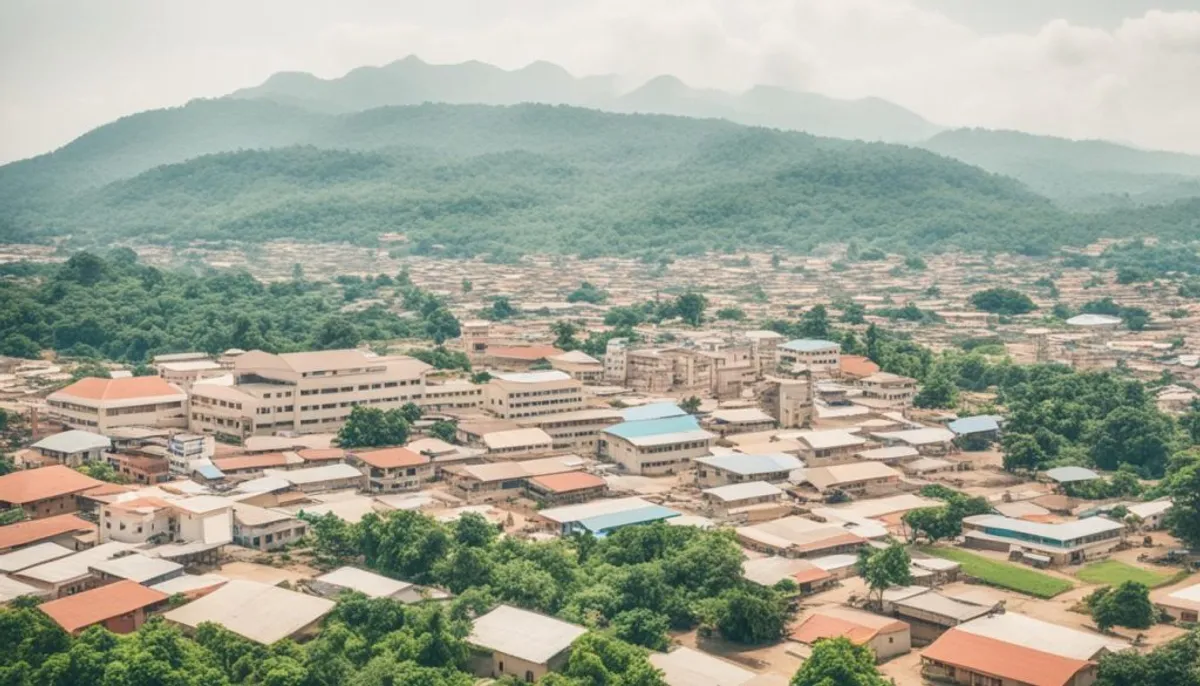
Main cities and prefectures of Togo
Lomé and the Gulf prefecture
Lomé is the capital of Togo. It is also its economic and political center. It is located in the Maritime region. Lomé has about 1.5 million inhabitants. This city is very active economically, administratively, and culturally.
The Gulf prefecture includes 6 municipalities and 5 cantons. It has Lomé as its capital. And also the country's main deep-water port. This port is essential for Togo's economy.
In addition to Lomé, the Gulf has other key cities. For example, Aného, Vogan, and Tabligbo are located there.
Sokodé and the Central prefecture
Sokodé is in the Central region and is the third largest city in Togo. After Lomé and Kara, Sokodé has about 150,000 inhabitants. It is the capital of the Central prefecture.
The Central prefecture has 7 municipalities. These municipalities are divided into 7 cantons. Bafilo, Tchamba, and Sotouboua are other important places.
Sokodé is a major commercial and industrial center. This city plays a key role in the economy of its region. It has several processing plants for agricultural and mining products.
History of administrative subdivisions
The division of Togo dates back to the colonial era. The Germans divided the country into circles in the 19th century.
Colonial legacy
After the 1914 war, France and the United Kingdom divided Togo. The territory was then divided differently.
France organized the regions and prefectures, changing the circle system. This change followed the model of French West Africa.
Evolution after independence
The division changed after Togo's independence in 1960. New regions and prefectures were created.
Until the 1980s, there were 30 prefectures in 5 regions. But in 2019, the reform increased the number of prefectures to 39.
This demonstrates the desire of Togo's leaders to modernize the territorial division. It also aims to make administration more efficient.
Today, Togo has a very precise division that takes local needs into account.
Challenges and issues facing Togolese prefectures
Decentralization and local autonomy
Togolese prefectures are progressing in decentralization. However, they face significant challenges. These obstacles prevent them from fully exercising their powers and ensuring the autonomy of local communities.
Strengthening technical and organizational capacities is crucial. It is also essential to clarify everyone's roles. This includes the missions of the state and those of local communities. Good coordination among all levels of administration is paramount.
Financial and human resources
Togolese prefectures face major challenges in funding and personnel. Even with state support, they often lack adequate financial resources. This makes it difficult to carry out their tasks and support local development.
They also struggle to recruit and retain qualified human resources. Poor working conditions and low salaries are barriers. This lack of financial and personnel resources affects the efficiency of the prefectures.
Reforms and future perspectives
In recent years, Togo has embarked on significant changes. It aims to strengthen the actions of local communities. To this end, reforms are underway.
New laws and territorial reorganization
In 2019, a law was amended for greater decentralization. This law allowed for the creation of 9 new prefectures. Now, the country has a total of 39.
Togo is also working to better define the roles of each level of local administration. It seeks to provide more resources, whether in money or personnel, to the prefectures.
These changes have a clear goal: to help prefectures play an active role in economic and social progress, improving the effectiveness of prefectures. This follows the strong principle of decentralization.
Additional information
Demographic data by prefecture
Togo has 39 prefectures. Let’s look at how the population is distributed across these regions.
The most populated prefectures are:
- Gulf Prefecture (Maritime region): 2,599,955 inhabitants
- Kara Prefecture (Kara region): 1,336,869 inhabitants
- Plateaux Prefecture (Plateaux region): 1,263,725 inhabitants
The least populated are:
- Bassar Prefecture (Kara region): 198,997 inhabitants
- Tchaoudjo Prefecture (Central region): 211,965 inhabitants
- Doufelgou Prefecture (Kara region): 220,324 inhabitants
The number of people per region shows significant differences. More people live near the capital Lomé.
Maps and visualizations
Maps help to understand where the prefectures are located in Togo.
You can see maps showing the regions and their capitals. They help with orientation.
The maps also show population density. This can be very interesting.
Seeing Togo on a map helps to understand its organization. It speaks of its regions and its former subdivisions.
Conclusion
Today, Togo has established 39 prefectures in 5 regions, following a change in 2019. This helps administration to be closer to citizens. And it helps to empower local governance.
Prefectures are very important for managing cities and their progress. They act on behalf of the state locally and organize services.
However, they face challenges, such as budget and personnel shortages. This can sometimes limit their work. Changes are planned to give them more power and resources.
Tomorrow, there is still a need to further support prefectures and decentralization. This is to help Togo develop equitably and include everyone.
FAQ
How many prefectures does Togo have?
Togo has 39 prefectures. They are located in its 5 administrative subdivisions.
What are the 5 administrative regions of Togo?
The 5 regions of Togo are: Maritime, Plateaux, Central, Kara, and Savannes.
What is the distribution of prefectures by region?
Here is how the prefectures are distributed: Maritime has 8, Plateaux 9, Central 7, Kara 8, and Savannes 7.
What is the role and functions of prefectures in Togo?
Prefectures manage locally. They help implement policies and develop territories economically and socially, taking into account land use planning.
What are the main cities and prefectures of Togo?
The main prefectures include Lomé in the Gulf and Sokodé in the Central region.
What challenges and issues do Togolese prefectures face?
Prefectures need more strength, clearer roles, and more resources such as money and personnel.
What reforms are underway to strengthen decentralization in Togo?
Decentralization has been supported by new laws. In 2019, 9 new prefectures were created, bringing the total to 39.